Tracing of Stitches
Stitches pg 220

ENGRD101.24. Spring 2022. Emory University
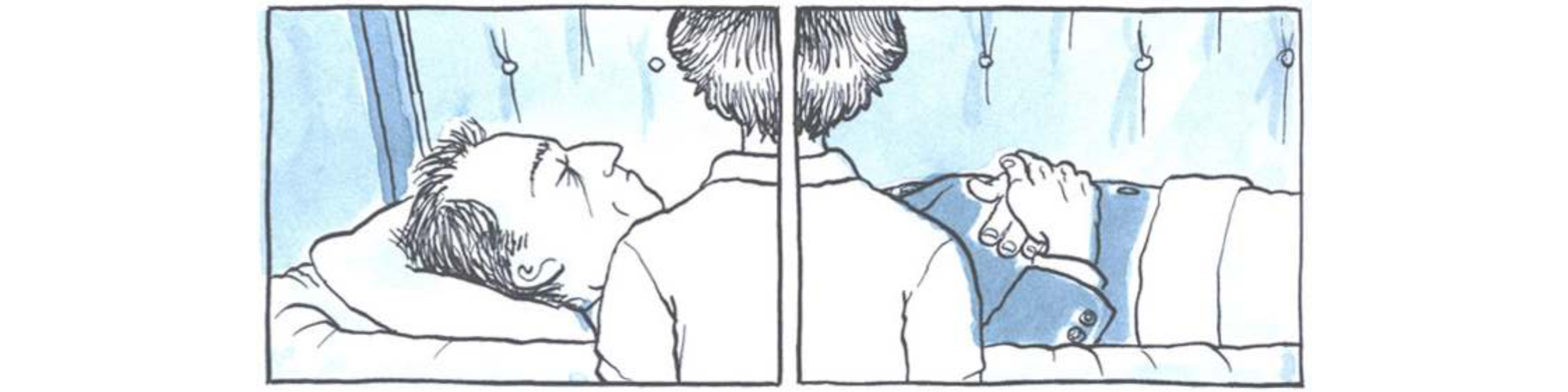
Stitches pg 220
The process of tracing the two pages for Symbols: WHAT DOES THIS MEAN was demanding. It took a long time for me to decide what specific page I would like to trace and analyze. I also thought that the assignment would have been easier if I could refer to more than just a single page and explore it together. Especially for Stitches, which had many pages that symbolized David’s status, it made it hard for me to choose one. When I was tracing the selected pages and scanning them, I was not sure what the problem was, but it became blurry, which was a thing that I didn’t expect. I got to think about the secret language of comics, focus on the details of the authors, and analyze the purpose of using such drawings. I think it was the process of analyzing the page for a long time that allowed me to think about the secret language of the author naturally. It took some time for me to make my thesis statement in the ABT format, but it was interesting to write a thesis statement in the last paragraph. Also, during the process of tracing, annotating, and analyzing these pages, I learned that comics are not something just for kids and superheroes but can be profound as a book and be highly descriptive as a poem.
This quadriptych process was simple, straightforward, and felt more natural than a triptych. The challenge is finding something meaningful to start with, or an interesting enough twist or climax. Having the middle act stretch across two panels led to a more natural storytelling process. I think this taught me that the more panels you have to work with, the more you can add to the narrative. Too much makes it less punching, but four panel structure seems a very sound structure / good number. I think themes of gun violence made this a controversial comic strip, but hopefully the donuts being at the foreground and the gore coming from Boston Kreme filling made for a lighthearted comic. I chose a comic of this caliber as I wanted to add some unique twist to a seemingly casual cartoon of donuts, as if it was a grown up version of an innocent comic I would read as a younger kid. I thought this content matter could be accepted due to the extremely emotionally harsh subject matters present in the comics read for class.

First, I was met with the difficulty of setting up a story. I chose a relatively funny one that I had experienced in my childhood. I divided the story into four panels read from left to right. I do not believe there was any real challenge for this assignment. This was actually easier to execute than the triptych because I had one more panel to explain the story. The layout of the story was done in a way that I think would be easier to read and by splitting the middle scene in two, I was able to give further perspective.

Making this Quadtriptych involved a brief reflection of the sort of conversations I have had with people regarding the current situation in Ukraine. Mostly between my roommate and I, these interactions are almost daily where we exclaim at the unfortunate reality in Ukraine and almost immediately switch to something else more pertinent (i.e. homework, getting food, or watching youtube).
I am not trying to make a claim about how normal citizens are supposed to stand up, drop everything they are doing, and take immediate action to end this conflict, but at the same time, it is just bizarre how normal we are with a situation that could very easily escalate into something much larger.

This assignment was not as difficult as drawing the triptych. Triptych and quadriptychs are pretty similar. A quadriptych is just making the middle part of the story. The idea came pretty quick to me after looking at a couple of comics by Nathan Pyle. Having the middle act stretch across two panels made story telling a little easier than in a triptych. I made this my story because it would be interesting if the moon and sun had thoughts and looked at what was going down in the world.

I came up with many kinds of classical quadriptych tricks but decided to appeal to poetry. Coincidently, a quadriptych has four panels to fill for each of the four imageries I really appreciated in Jorge Luis Borges’ poem What Can I Hold You With: the lean streets, desperate sunsets, lonely moon, and the yellow rose. The comics has one even more advantage than Borges’ lines of poetry: comics could create the symphonic effect and render all four melancholic symbols to readers’ eye at one time, but poetry things go in order of the words. I hereby attach the entire poem:
What can I hold you with?
Jorge Luis Borges
   What can I hold you with?
   I offer you lean streets, desperate sunsets, the
      moon of the jagged suburbs.
   I offer you the bitterness of a man who has looked
      long and long at the lonely moon.
   I offer you my ancestors, my dead men, the ghosts
      that living men have honoured in bronze:
      my father's father killed in the frontier of
      Buenos Aires, two bullets through his lungs,
      bearded and dead, wrapped by his soldiers in
      the hide of a cow; my mother's grandfather
      - just twentyfour - heading a charge of
      three hundred men in Peru, now ghosts on
      vanished horses.
   I offer you whatever insight my books may hold,
      whatever manliness or humour my life.
   I offer you the loyalty of a man who has never
      been loyal.
   I offer you that kernel of myself that I have saved,
      somehow --the central heart that deals not
      in words, traffics not with dreams, and is
      untouched by time, by joy, by adversities.
   I offer you the memory of a yellow rose seen at
      sunset, years before you were born.
   I offer you explanations of yourself, theories about
      yourself, authentic and surprising news of
      yourself.
   I can give you my loneliness, my darkness, the
      hunger of my heart; I am trying to bribe you
      with uncertainty, with danger, with defeat.

Link to Poetry: https://www-ccs.cs.umass.edu/cris/texts/two-english-poems.html

When composing my quadriptych I tried to think of something that was on the simpler side but also creative. One thing that was challenging was trying to think of an idea what would be easy to draw but still interesting to read. This is relatively similar to the triptych because there is the same level of creativeness that is required but the comic storyline spans for a longer amount of time. This in a way was difficult because there had to be more to the actual story of the comic. The span of the two middle panels versus one made the climax of the comic span on for longer but it did not make it any more difficult. I told this story because I thought of this out of nowhere and I think it is a cute idea. I think I could have added more detail but overall I like how my quadriptych turned out.
The process of tracing and annotating allows me to dive into the images and recognize the details that got ignored when I was reading the comics at a normal pace. For instance, it allows me to realize the effort Bechdel put into depicting all the details of surroundings in her room: the clothes in the closet, the curtain beside the desk, or even the labels on the cupboard boxes, all of which contribute to enhance a sense of realism. The details also reflect lots of unobvious contrasts: like the different dressing styles of mother and daughter which are reflective of their diverging personalities. For Stitches, it made me notice that the author employed different shades of grey intentionally to emphasize his feelings of depression through the use of shadows on certain areas. Through shadows, he’s actually creating different lighting effects that help to establish the atmosphere.
Initially, I was struggling to organize my ideas into an ABT structure because all the patterns I was planning to analyze point to one general conclusion, so it may easily become an essay with three parallel body paragraphs. So I spent some time reorganizing my thoughts, trying to find if there exists a progressive argument that allows me to gradually dive deeper into my analysis instead of presenting a general rule in the opening paragraph and using all the other paragraphs to prove it. Eventually, I decided to have two body paragraphs, one on visuals and the other on texts, but I will save my concluding remarks to the end which enables me to gradually unfold my arguments.
The title of my essay is “the hidden storyteller”, which resonates well with the focus of the course “secret language of comics.” The process of slowing down and reading one page for several times significantly enhanced my understanding of the comics, and it was during the process of writing about them and comparing the two comics that I was able to notice the patterns I ignored. For instance, after I decided to focus on the representation of emotions in both comics, I began to notice the various ways employed by the two authors that are reflective of how they dealt with emotions. Especially for Fun Home, it was through comparing it with Stitches that I realized how emotionally detached it is. It feels like a documentary of the past, and the narrator is trying to explain it, interpret it, and reflect on it by analyzing herself. On the other hand, Stitches is sentimental, passionate, the emotions are powerful.
