I chose to track my productivity. I used the categories: hrs spent on phone, motivation, naps, stress, hrs spent on academic work. I chose these as categories because they all affect how productive I can be. The question I was hoping to answer was: what has a greater influence on my productivity?
Based on my data, I tend to be unproductive on Fri-Sun. I think the main factor for this would be due to the fact that I do not have classes I need to attend, besides one. I do tend to get distracted a lot more on these days than on the weekdays. Another thing I noticed was that I do spend a lot of time on my phone than I would like. The longest time was around 6 hours. I hope to work on this habit. Although, I did think that the hours would’ve been a lot higher.
To answer the question, factor that has the most influence on me would be how motivated I was. This makes sense, because if I have to force myself to do something, it would be easy to distract myself by using my phone. I noticed it really influenced most of my other categories like stress.
If I were to continue this, I would focus on something other than my productivity. I would like to do something a lot more deeper, maybe something dealing with mental health related. I think that I could have taken this assignment a lot more seriously, maybe I would have learned something a lot more useful.
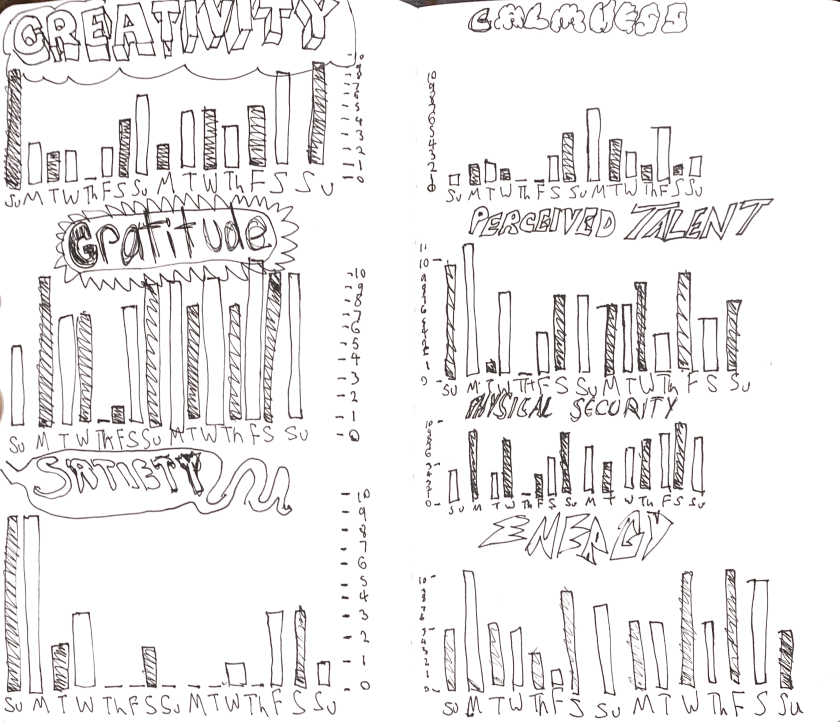
For this assignment, I really tried to find qualities in my life that are important enough for me to contribute to my happiness. If one area is lacking, for example, it would appear that one of these quantified traits would either be the cause or effect related. I ranked two full weeks day by day, three Sundays, into a 1-10 format. In doing this, I felt it captured my complicated aspects of what it means to be happy. I found creativity to be an important aspect of my creativity. For example, if I was feeling really creative and inspired, I would feel self worth and accomplished. On average, it appeared that the days where I felt most creative coincided with days where the other traits were high, thus appearing to be a good attribute or sign of happiness or positive brain processes. It also appeared that the creativity was in relatively uncommon/ short supply, not often brought out to the fullest. Gratitude was a fairly interesting one, as overall, I felt extremely happy these past two weeks, and I found this was the most profound or clear cut cause and effect reason for my good mood: I had so much to be grateful for, and reminding myself and being aware of that every day contributed to my overall happiness. The days where there was extreme dips in gratitude were some of the more upsetting days, but quickly a change of perspective kept my spirits up. Satiety is an incomplete goal to this day of measuring my happiness. As although I felt happy these past weeks, I couldn’t get a hold of my satiety: I always felt hungry and consistently held patterns of overeating. Keeping this in control would help me to feel as though I had control over myself and my feelings and was a good indicator of complete happiness in days where it was high. This is something that I would continue to measure if I had more time and find very insurmountable to self improvement, in addition to gratitude. I found that I almost never had an inner calmness in me these past two weeks, something that proves that to me, being all that calm isn’t a completely necessary indicator of happiness. Having a bit of stress to keep me going I found worked best for me: being overly calm seemed to be a sense of ignorance that isn’t realistic. My perceived talent is also semi related to gratitude: if I felt I had talent and self worth on a given day, I would be this grateful and happy. Perceived talent was also a great indicator in that it was indicative of the fact that I accomplished various tasks on these days and had done so in a manner that had given me something to feel talented for. Physical security is a semi shallow yet meaningful aspect to my overall happiness: if I was confident in my body, I would thus be confident and happier overall. My eating habits and satiety can sometimes interfere with this, and on days where my fullness was especially low, it wasn’t uncommon that I would also feel less secure in my body as a result of my eating habits. Overall, however, this data also proved that I general was secure and confident in my body, thus a good indicator of happiness. Being reflective of my energy was very interesting for me, as over these past two weeks, I have been super energized more than normal, thus proving to be a good indicator as well of happiness. Overall, I thoroughly enjoyed and found it profoundly beneficial to checking in on myself on a daily basis in the fields that felt significant for me and my perceived happiness. Although there was a limited sample size, I think doing this assignment whether coincidence or circumstantial did in fact coincide with my overall elevated perception of happiness. Whether I explicitly record data and keep this up or not, to keep an overall pattern of self reflection is a good way to know if I am happy, as well as improve my life in certain fields if I see one of these traits is lacking. Thus, if one area is lacking, ir might be a good self diagnosis as to contributing to my feelings of diminished wellbeing.
For the data visualization activity I decided to measure my productivity levels while listening to different genres of music. I decided to rate my feelings on the questions I wrote before tracking the data on a scale of 1-10, one being very little agreement and 10 being a strong level of agreement. When creating the chart I took the averages of each answer to the question and created a bar graph. I believe that I was able to answer my original question of which genre of music was the most effective in helping my productivity levels. I was able to conclude that when doing work and listening to music, it helps if I enjoy the type that I am listening to. When I did not know the words or the artist of a song, I felt that I was more distracted and fixated on trying to listen and see if I liked the song. I was able to conclude that I work best when listening to R&B music. Also, I realized for some types of work such as reading a textbook or an article, it was harder to process the words I was reading as I was listening. Hearing something while reading another thing hindered my ability to effectively complete my homework.
I decided to visualize my data in this way because I have always tried to change up what type of music I listen to while doing different activities. I decided to measure how it influenced my productivity levels because I am always looks for new ways to be more efficient when doing my work. I feel like I can be easily distracted so I think that this activity helped me process what I should and should not be doing when completing certain homework. I think that if I were to do this activity again in the future I would be sure to include how working around others while listening to music influences my productivity as well. One thing I regret not including was how productive I felt when listening to no music at all. I think that I sometimes need the headphones to help focus in on what I am doing and other times I use the music was an excuse to go on my phone. Overall, I believe that this activity was a valuable tool for self analysis and I would be interested to see the other things I could potentially measure in my life in the future.
The first five graphs above were hard/explicit metrics I collated over a span of two weeks that I thought could best represent my health every day. The five categories were the amount of times I looked at my phone for more than 3 minutes, how many fruits I had eaten, how much water I had drank, my average heart rate, and the amount of sleep I got the previous night.
By taking these metrics and standardizing them (higher values of negative metrics i.e. times I looked at my phone and heart rate were made negative and vice versa) I was able to create a 0 to 1 range of my health for that day
This is reflected in my sixth graph showing my health per day. It accurately shows my health where, on days where I drank lots of water and ate plenty of fruits, my health was high.
Now looking at the data in front of me, I realize I need to make my health a larger priority and stay consistently high throughout the week. These metrics turned out to be great tools for measuring health because now I know exactly what I need to improve on to increase my health quotient for that day. I was able to effecitvely answer my question of whether my habits were conducive to a healthy lifestyle.
I picked the three measurements crucial to my life that are not so easily quantifiable. I utilized Numbers to visualize data, which was really convenient. I picked up keeping a diary a few weeks ago, so luckily helped a lot for this project.
3/21: Skipped 8:30 morning class to sleep, felt good about making the right decision. Confirmed summer research offer from IAS. Talked to more than one first-year student other than best friend. Doubted my intelligence as usual in Math 523, but appreciated the 5:30pm vector spaces class. Backed on a promise to work out at night, but walked a lot in the day.
Fulfillment: Academic: high; Spiritual: medium; Belief in Human Relationship: high
3/22: Skipped differential equations class – a right choice. Attained permission codes for fall registration from DZB; waitlisted by some summer program, felt anxious. Exercised for 2 hours, loved the empty track field and starry night. Wanted to talk to some peers but ultimately didn’t do it.
Fulfillment: Academic: high; Spiritual: high; Belief in Human Relationship: medium.
3/23: Dreamt of a strange real-life event in high school, but characters in which were people I met in college. Didn’t skip 8:30 class, right choice – interesting new material on the voting systems; understood a whole Math 523 class for the first time, exhilarated. Ate a lot. Talked to more than one first-year student other than best friend.
Fulfillment: Academic: very high; Spiritual: medium; Belief in Human Relationship: high.
3/24: Didn’t skip differential equations – right choice; didn’t fully understand the technique taught in class. Wanted to talk to some peers but didn’t do it. Fixed almost everything for this summer in the States – summer school, travel, research, and housing. Attained all 5 permission codes for the fall. Played basketball, ran, and worked out.
Fulfillment: Academic: medium; Spiritual: very high; Belief in Human Relationship: low.
3/25: Happy conversation with an old friend, then fell into existential crisis – didn’t know what do in the future a classical struggle between bread & dream. Then met an annoying guy from first floor, who tried all dinner to convert me to CS major (which I partially am). Back to dorm without exercise, listened to Mahler – another long-lost friend – and regained some tranquility. Almost a day with no productivity and going to bed with existential crisis, until I discovered a brilliant article on Markov chains and Gerschgorin’s Disk Theorem, exposing a hidden facet of the world of probability, exhilarated.
Fulfillment: Academic: High; Spiritual: low; Belief in Human Relationship: medium.
3/26: Had a good DCT Saturday brunch with a friend, spent 2 hours in South American section in Carlos Museum, picked a cup of Ebrik coffee, and lay in quad for half an hour with him. Went back to dorm and finished Markov chains and lots of differential equations material in a mental flow. At dinner, discovered the fact that I could cut and eat oranges in DCT. Appreciated Karen Mok’s classics and had a nice shower. Talked to more than one person.
Fulfillment: Academic: very high; Spiritual: high; Belief in Human Relationship: high.
3/27: Doesn’t feel very well. Felt anxious about two presentations and summer school coming up at the beginning of April. Desperate about human relationships, my future, and my finals. (In progress)
Fulfillment: Academic: medium; Spiritual: low; Belief in Human Relationship: low. (In progress)
This week I have been particularly busy and anxious so I decided to keep track of my feelings of anxiety and visualize it in order to better identify the sources and potentially improve my overall mental health.
The measurement is based on three types of anxiety: social, academic, and existential. Since I have been writing dairies on a daily basis for almost six years, it’s easy for me to keep track of the events and feelings during the day so I didn’t particularly change my way of recording and simply remind myself to include more details while writing.
Overall, I found that I usually enjoy Monday, Wednesday, and Sunday because I enjoyed the classes more and I was occupied by work so didn’t really have time to overthink. Thursday was my most anxious day because I was experiencing anxiety from all three perspectives, while on Friday and Saturday even though there were stressful events but they were balanced off by the enjoyment I got from other perspectives.
Through the assignment, I proposed several ways to lower my anxiety level: 1/take courses that you really enjoy and try to make friends in class 2/If Tue/Thu are usually stressful, leave sth fun to do on these days (like new episode of the radio) 3/try to avoid using social media when ur already stressed out by school work, and block your ex
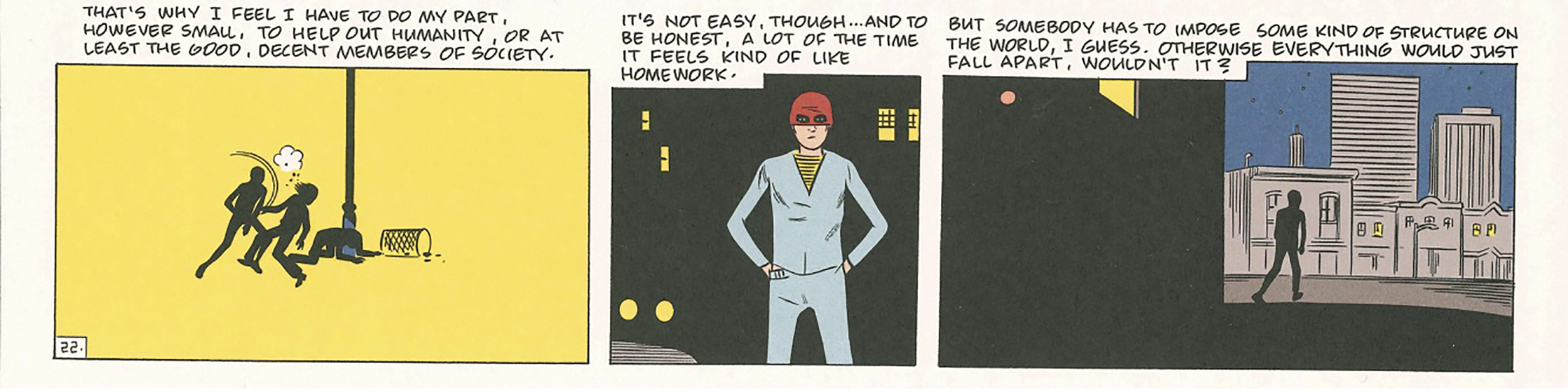
Overall, I enjoyed this Literacy Narrative Comic as it was able to reflect the first assignment into comics. While creating this comic, I had various ideas about how I should express my story in drawings. After receiving some feedback on my initial storyboard, I adjusted some changes into the comic and focused more on how I developed myself as a writer and reader. As I am not a good drawer, I was concerned about how my story couldn’t be delivered in the way I intended. However, I still tried my best to deliver the message that I wanted to offer by using creative ideas with an extra explanation about how I reached such a situation in the comic.
If I had the opportunity to, I would like to hire a professional illustrator to make a comic about my life and how I was able to develop not only as a writer but also as a human being. The specific scene that I would put in the most work would be the scene where I study at my Grandma’s house. This was where I stayed during the summer break before my senior year and was entirely focused on my studies and is a symbol of my most passionate and motivated period of time. The most important part of this scene would be expressing its relaxed and peaceful atmosphere with a student fully dedicated to his studies.
During this activity, I was able to develop the ability to summarize, analyze, and evaluate the ideas of others as I undertook scholarly inquiry to talk about my story in developing the way I read and write and eventually come to Emory.
This assignment was very different from the other assignments we have done before because this had a segment regarding tracing pages. Tracing the pages in this assignment made me realize the author’s thought process while he/she was drawing it. They focused on each panel and every specific image in this comic strip. The formation of the thesis was different for me because I was very used to the thesis being straight to the point located in the beginning of the essay. I feel like I understand more about comics in general along with these specific comics because this assignment pushed me to dive deeper and focus on things below the base level. This includes focusing on the tone and images in these comics. I would say the biggest thing I have learned from this is the openness of comics and how it is up to the reader to determine the relationship between the story and the panels. The thesis of my tracing pages is found below, “Page 255 of Stitches and Page 58 of Fun Home are both very important moments in the play because they are turning points of each narrative and indicate a certain realization on the part of the protagonist but consequently the characters learn new things that they weren’t aware of in the beginning.”
My thesis in my essay was that David Small and Alison Bechdel use repetitive images and choice of frame strategically to aid their storytelling, but while these tools allow Bechdel’s illustrations to better support her written narrative, they allow Small to let his illustrations stand alone, therefore making audience participation more straightforward in Stitches and broader in Fun Home. In my essay, I argue that Small and Bechdel utilized similar rhetorical devices in the creation of their respective pages, but because of the difference in their use of language, the results of these devices created very different experiences for the reader.
When completing the tracing pages assignment, the first steps of actually tracing and annotating the pages were very useful when completing my analysis. I usually don’t know where to begin or what to focus on when annotating documents, so I found your directions very helpful because I was able to systematically go through each rhetorical tool or method and determine where and how it was being used on my selected page. Something I did that really helped me to compare the two authors’ pages was including a list of what I thought the top three most important/relevant clarity terms were for each page. For Stitches specifically, the act of tracing the page made me really pay attention to David Small’s linework, which made me think about why he chose to include the details he did.
The essay part of this assignment was really hard for me because I am not used to writing inductive essays. I had a lot of ideas from annotating the tracings, but the amount of evidence overwhelmed me because I couldn’t figure out how to neatly organize it all. I ended up typing out all of my annotations and sorting them into broad categories on a google document. From there I drafted an argument based on the patterns I saw and started to piece together my essay. I had to rewrite/rearrange my paragraphs a lot more often than I usually do when writing essays because I would forget to write them in an inductive format. Overall, the hardest part about this essay was coming up with an ABT thesis in the last paragraph.
I think this assignment did help me understand the secret language of comics a lot better. After close reading the pages it became very obvious to me how conscious every decision is in the creation of a single page, not to mention a whole book. I definitely have a better understanding of the themes of both Stitches and Fun Home after completing this assignment. It was also very interesting to see how similar the comics are to each other. Individually, something about Fun Home that clicked for me while completing this assignment was that Alison Bechdel was comparing herself to her father throughout the comic. Also in Stitches, I noticed that facial expressions have a huge impact on the mood of Stitches.
The problem I wanted to tackle with this project was the effect five fairly mundane lifestyle habits had on my general happiness. I admittedly selected a unique set of days to track data as I spent 03/11 and 03/12 in London with some of my friends on spring break, 03/13 in an airplane flying back to Atlanta, and 03/14 and 03/15 doing an ungodly amount of school work. I imagine if I were to repeat this process over seven ordinary days, my findings might be slightly different.
I found that a good night’s sleep generally added to my happiness. However, extraordinary circumstances might have overruled the effect sleep had on my well-being over those days. However, my eating patterns certainly had a noticeable relationship with my happiness. I found that three meal days contributed to me being relatively happy. Although the days I ate three meals pales in comparison to the previous days, my ability to maintain a healthy eating schedule made those days better than they could have been. I found that typically when I was eating four meals, it was because I had not eaten three complete meals earlier in the day and became ravenously hungry, resulting in a second dinner of sorts.
I did not drink out of my water bottle as much I had expected to while I was in London, partially due to my access to other fluids but also partly due to neglect. I found that I typically drank more when I was isolated in my room with my water bottle being my exclusive source of fluids. In this sense, I don’t think that metric as I measured it was very effective. I do, however, believe that there is some correlation between my general hydration and my happiness levels. The same can be said for the time I spent exercising. Although I spent a lot of time on my feet whilst in London, I suspect I would have been equally as happy viewing the city while on the top of a guided tour bus. Being somewhere exciting contributed to my happiness more than my physical activity.